

TL;DR
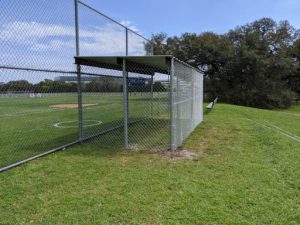
The honest answer to “should I get a chain link fence?” depends entirely on what you need it to do. Chain link fence pros and cons come down to a simple trade: it’s the most affordable and durable open-mesh fence option, but it offers no privacy and limited curb appeal. It makes sense for backyards where containment matters more than looks, for commercial perimeters, sports courts, dog runs, and large rural lots. It rarely makes sense for front yards, HOA neighborhoods that ban it, or any property where appearance and privacy are priorities.
Chain link gets dismissed too often. Some homeowners hear “chain link” and immediately think of school yards or industrial lots, then write it off without considering whether it actually fits their property. Other times, the opposite happens: a homeowner picks chain-link fencing to save money and ends up with a fence that doesn’t do what they need. Both outcomes come from skipping the same question: what’s the fence actually for? This guide walks through the real pros and cons of chain link fencing and the use cases where each one matters most, so you can decide when to use chain link fencing and when another material is the better call.
What chain link fencing is (briefly)
Chain link is woven steel wire formed into a diamond mesh, stretched between metal posts. The mesh comes galvanized (silver) or vinyl-coated (typically black, green, or brown). Heights range from 4 feet for residential to 12 feet or more for commercial and security applications. The defining trait is the open mesh: you can see right through it, and so can everyone else.
If you’ve already decided on chain link and want help on specs (mesh size, gauge, coating choice), our guide on choosing the right chain link fence covers the technical selection. This post is about whether chain link is the right choice in the first place.
The pros: where chain link delivers
It’s the most affordable durable fence option.
Chain link installation typically costs 30 to 50 percent less per linear foot than wood privacy fencing and less than half what ornamental iron costs. The savings come from cheaper materials and faster installation. For long perimeter,s especially, the cost difference is significant.
It lasts a long time with almost no maintenance
A galvanized chain link fence regularly lasts 20 to 30 years in Austin’s climate. Vinyl-coated lasts longer (and looks better) but costs more. There’s no staining, no painting, no annual sealing. Hardware and posts are the main wear points, and they’re cheap to replace. For an existing chain link fence, see the chain link fence care guide.
It contains pets and kids without blocking visibility.
Chain link is one of the best fence types for keeping dogs in while still letting them see out, which many dogs prefer. Mesh sizes can be matched to pet size, and privacy slats or screening can be added later if visual barriers become a priority. For a deeper material comparison from a pet-owner angle, see how to choose between chain link, wood, and iron fences for pets.
It installs faster than other fence types
A typical residential chain link install takes one to two days, whereas a comparable wood privacy fence takes three to four, for owners who want a fence up quickly (new pet, finishing a yard before a deadline, securing a worksite), the speed matters.
It handles the weather well
Open mesh lets wind pass through, which means chain link rarely fails in storms the way solid privacy fences do. Galvanized steel handles humidity and rain without rotting or warping. Hail can dent vinyl coating but rarely affects function.
It works on slopes and uneven terrain
Chain link can be installed to follow the ground contour smoothly. Wood and panel fences struggle on slopes because the rigid panels create either visible steps or gaps along the bottom. Chain link’s flexible mesh handles uneven ground without those compromises.
It’s customizable beyond the standard look
Vinyl coating in dark colors (black, brown, dark green) makes the chain link far more visually acceptable than the standard silver galvanized look. Privacy slats woven through the mesh add visual screening when full privacy isn’t needed. Decorative top rails and post caps can dress up an entrance.
The cons: where chain link falls short
Zero privacy
This is the trade. Chain link’s open mesh is its biggest strength (visibility, wind handling, durability) and its biggest weakness. Anyone on the other side of the fence can see in. Privacy slats help, but don’t fully solve the problem, and they reduce the fence’s clean look. If real privacy is the priority, wood or vinyl is the right call.
Limited curb appeal
Even with vinyl coating, chain link reads as utility fencing to most people. It works in the backyard. It struggles in the front yard, especially in neighborhoods where the visual standard is wood privacy or ornamental iron. Property value typically takes a small hit when the visible fencing is chain link.
Many HOAs ban or restrict it
A lot of Austin-area HOAs explicitly prohibit chain link in visible locations, especially front yards. Some ban it across the entire property. Before assuming chain link is an option, check your HOA fence rules. If you’re in Round Rock specifically, Round Rock HOA fence rules cover the local specifics.
Easier to climb than other fences
The diamond mesh provides foot and hand holds. For security applications, chain link works best with additional features (height, barbed wire top, anti-climb plates) rather than as standalone protection. A determined climber can clear a 6-foot chain link fence faster than they can clear a 6-foot solid panel.
Doesn’t block noise or wind
If you want a fence to reduce road noise, block wind from a pool area, or shield a yard from gusty conditions, chain link won’t do it. The open mesh that helps with storms is the same feature that fails at acoustic and wind screening.
It can look industrial in the wrong setting
Standard galvanized chain link on a residential front yard tends to read as institutional. Vinyl coating helps, but the underlying form factor is still recognizable. In neighborhoods with high curb-appeal expectations, this matters.
Where chain link makes sense (the use cases)
Chain link is the right choice for properties where the job is containment, durability, or perimeter security, and where appearance and privacy aren’t the main priorities:
Backyard dog containment
If the fence is in the back yard and the main job is keeping the dog in, chain link does the job at a fraction of the cost of wood privacy. The dog can see out (often a behavioral plus), the fence handles weather, and you save real money.
Sports courts and play areas
Backyard basketball courts, tennis courts, batting cages, and play areas all benefit from chain link. Balls don’t break, you can see through them, and tall heights are cheap.
Garden enclosures
Vegetable gardens that need protection from deer, rabbits, and other wildlife. A chain link with the right mesh size and height keeps animals out without blocking the sun.
Commercial and industrial perimeters
Storage yards, equipment lots, parking lots, and similar commercial properties are where chain link genuinely excels. Cost, visibility for monitoring, durability, and easy gate integration make it the default for commercial perimeter security. For broader context, see security fence options for Austin businesses.
Large rural and acreage perimeters
On larger properties where running wood or iron the entire perimeter would be financially impractical, chain link offers visible boundary marking at a manageable cost. Often used in combination with other materials, with chain link on the back sections and a different material on the visible frontage. For acreage projects specifically, see acreage and ranch fencing in Buda TX.
Temporary or transitional fencing
Construction sites, event perimeters, or properties where a permanent fence decision hasn’t been made yet. Chain link goes up fast, comes down fast, and the components retain resale value.
Slope-heavy yards
Yards with significant grade changes where wood fence panels would create steps or gaps. Chain link follows the contour smoothly.
Where chain link doesn’t make sense
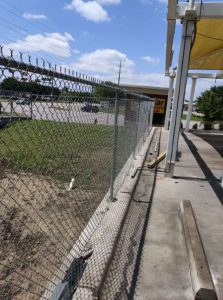
Some properties and use cases are clear-cut wrong fits:
- Front yards in HOA neighborhoods. Most won’t allow it, and even where it’s allowed, the curb appeal hit usually isn’t worth the savings.
- Privacy-focused back yards. Pool areas, hot tubs, outdoor entertaining spaces. A wood privacy fence is the right tool here. See our guide on wood privacy fencing in Austin.
- High-end residential properties. Where the home is in the $1M+ range, and the surrounding properties feature ornamental iron, stone, or premium wood, chain link looks out of place. See our guide to ornamental iron fencing in Austin for a better-fitting upgrade.
- Properties where appearance matters more than function. If you’d rather pay more for something that looks great than for something purely utilitarian, chain link will disappoint.
- Pool enclosures with code requirements. Some pool codes specifically require non-climbable fence designs. Chain link’s mesh provides foot and hand holds, which can fail pool code in many jurisdictions. Always verify pool fence requirements before assuming chain link works.
- Climbers (kids or otherwise), you need to keep out. Chain link is among the easiest fences to climb. Use solid panel materials or iron with smooth pickets for serious deterrence.
Cost reality vs perception
Most homeowners assume chain link is dramatically cheaper than every other fence. It’s the cheapest, yes, but the gap closes when you add features:
- Basic galvanized chain link is the lowest cost option.
- Vinyl-coated chain link adds 20 to 40 percent to the price.
- Privacy slats add another 30 to 50 percent in materials and labor.
- Taller heights (8 feet, 10 feet, 12 feet) scale cost faster than wood does.
- Commercial-grade chain link with security features (barbed wire top, heavy gauge) can approach wood privacy fence pricing.
If you’re configuring a chain link with privacy slats and vinyl coating to make it acceptable in a visible location, the math often points back to a basic wood privacy fence at a similar cost. The savings argument only fully holds when you’re using standard chain link in its native role: back yard, back lot, or commercial perimeter.
Chain link vs wood vs iron: quick comparison
Factor | Chain link | Wood privacy | Ornamental iron |
|---|---|---|---|
Upfront cost | Lowest | Moderate | Highest |
Privacy | None (open mesh) | Full | None (open pickets) |
Maintenance | Very low | High (staining) | Low to moderate |
Lifespan | 20 to 30 years | 10 to 20 years | 30 to 50 years |
Curb appeal | Low | Moderate to high | High |
HOA acceptance | Often restricted | Usually allowed | Usually allowed |
For a deeper material comparison across all options, see our overview of fence installation materials in Austin.
Deciding what’s right for your property
Chain link is the right call when the job is containment, durability, or perimeter security, and the trade-offs in privacy and appearance are acceptable. It’s the wrong call when appearance, privacy, or HOA acceptance are priorities. Knowing which category your project falls into makes the conversation with a contractor straightforward.
If chain link looks like the right fit for your project, our chain link fence installation service handles residential, commercial, and rural projects across the Austin area. Reach out through the contact form or call (512) 354-7670 to schedule a free on-site estimate.