

TL;DR
A wood privacy fence in Austin is the most common type of fence you’ll see in residential neighborhoods, and for good reason. Cedar is the dominant material because it handles Texas heat and humidity better than alternatives. A well-built cedar privacy fence typically costs between $25 and $40 per linear foot installed, lasts 12 to 20 years with regular maintenance, and meets the design requirements of most Austin HOAs. The guide below walks through what wood privacy fencing actually is, the material choices that matter, what to expect in terms of cost and lifespan, and the cases where wood isn’t the right pick.
If you’ve driven through any Austin neighborhood, you’ve seen the standard issue: six-foot cedar privacy fence, vertical boards, dog-ear or flat top, set back from the sidewalk. There’s a reason it’s everywhere. A wood privacy fence in Austin is durable, affordable, customizable, and works with how most HOAs in the area are written. It’s the default for a reason. This guide is for homeowners who want to understand what they’re actually getting before they sign a contract. We’ll cover what a wood privacy fence is, why cedar privacy fence options tend to win out over alternatives, what cost ranges look like locally, and when wood is the wrong choice.
What is a wood privacy fence?
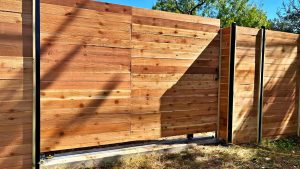
A wood privacy fence is a fence built from wooden boards spaced tightly together (or overlapping) to block sightlines into the property. Most are between 6 and 8 feet tall, depending on local code and HOA rules. Unlike a picket fence or a ranch-style fence, the goal is to block views, not just define the boundary.
The basic structure is consistent across designs:
- Posts (usually pressure-treated wood or steel) are set in concrete every 6 to 8 feet.
- Rails (horizontal supports, typically two or three) running between the posts.
- Pickets or boards (the vertical or horizontal wood surface) are attached to the rails. This is the privacy-providing layer.
- Cap and trim (optional) for a finished look and to protect the top of the fence from water.
Styles vary. Vertical board is the standard Austin look, but horizontal board has been gaining popularity for a more modern aesthetic. Board-on-board (overlapping pickets) gives total privacy with no gaps. Shadowbox alternates boards on each side for a fence that looks the same from both directions. For style inspiration, see wood fence ideas for backyards.
Why wood works for most Austin homes
Wood is the default privacy fence material in Austin for a stack of practical reasons:
- HOA-friendly. Most Austin-area HOAs explicitly require or strongly prefer wood for residential fencing. Vinyl, chain link, and ornamental iron often need special approval, while a standard cedar fence usually slides through with minimal back-and-forth. See HOA fence rules in Austin.
- Cost-effective per linear foot. Wood is typically cheaper than vinyl, ornamental iron, or composite at the installation stage. The trade-off is more maintenance over time, which we’ll cover below.
- Customizable. Height, board style, stain color, post caps, and trim can all be adjusted to match the house. Few other materials offer the same flexibility without custom fabrication.
- Repairable. A damaged board or post can be swapped without replacing the whole fence. Vinyl panels usually have to be replaced as units.
Cedar vs pressure-treated pine: which wood to use
In Austin, the practical choice is almost always cedar or pressure-treated pine. Each has trade-offs that matter in our climate.
Cedar (Western Red or Texas)
Cedar is the dominant choice for Austin residential fencing. The wood is naturally resistant to rot, insects, and decay, which matters when you’re dealing with high humidity, heavy summer rain, and termite pressure. Cedar also handles heat and UV better than pine, which means less warping and splitting in the long run.
The downside is cost. Cedar typically runs 30 to 50 percent more per board than pressure-treated pine; for a typical 150-foot backyard fence, that adds up.
Pressure-treated pine
Pressure-treated pine is the budget option. Chemical treatment helps it resist rot and insects, but it’s still less naturally durable than cedar. Pine is more prone to warping, twisting, and checking (small cracks) as it dries out in Austin’s summer heat. Expect more cosmetic issues over the same number of years.
If the budget is tight, pressure-treated pine works. Just plan on more maintenance and a shorter fence lifespan.
Other options worth knowing about
Some homeowners ask about redwood, ipe, or composite wood-look materials. Redwood and ipe are excellent but rarely cost-effective for residential fencing in Texas. Composite isn’t technically wood and gets covered separately. For a comparison of wood against vinyl, see cedar vs vinyl fencing in Austin and wood vs vinyl fencing.
What a wood privacy fence costs in Austin
Pricing varies by material, height, terrain, demolition needs, and gate count. The ranges below are typical for residential installations in the Austin metro:
Material | Typical cost per linear foot (installed) | What’s included |
|---|---|---|
Cedar (6 ft, vertical board) | $25 to $40 | Posts, rails, boards, basic installation. Excludes demolition of existing fence. |
Cedar (8 ft or board-on-board) | $35 to $55 | Taller fences or denser construction add material and labor costs. |
Pressure-treated pine (6 ft) | $18 to $28 | Standard build. Cost savings come from cheaper boards. |
On top of the linear-foot cost, expect line items for demolition of an existing fence, gate hardware, permits, stain or sealant, and disposal. For a more detailed cost breakdown, see the wood fence cost estimate guide for Austin and long-term costs of wood, vinyl, and iron fences.
How long does a wood privacy fence last in Austin
Lifespan depends on material, installation quality, drainage, and maintenance. General expectations for the Austin area:
- Cedar with regular maintenance: 15 to 20 years. Staining or sealant every 2 to 3 years extends life significantly.
- Cedar with minimal maintenance: 10 to 15 years. The fence still functions, but cosmetic decline is faster.
- Pressure-treated pine with regular maintenance: 10 to 15 years.
- Pressure-treated pine with minimal maintenance: 7 to 10 years.
Posts are the most common failure point. Posts in poorly drained soil rot from the base up, often before you can see it on the surface. Choosing the right material extends the whole project’s lifespan, so it helps to look at long-lasting fence materials for Austin.
Maintenance: what’s actually required
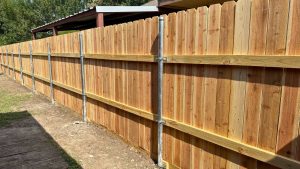
A wood privacy fence isn’t maintenance-free, but it’s also not constant work. The realistic schedule:
Every 2 to 3 years
- Clean the fence with a pressure washer or stiff brush and mild detergent.
- Apply stain or sealant. This is the single biggest factor in fence lifespan. For color guidance, see fence stain color options below.
Annually
- Walk the fence line and check for loose boards, leaning posts, gate sag, and any cracking or splitting.
- Check for rot at post bases (probe with a screwdriver to test for soft wood).
- Trim back any vegetation pressing against the fence to allow airflow.
After major storms
- Check for storm damage, especially on west-facing or unshielded fence runs.
- Look for new lean-in posts, particularly after heavy rain followed by quick drying.
For step-by-step maintenance specifics, see how to maintain a wood fence. For staining specifically, see the best fence stain colors for Austin.
HOA and city rules to know about
Most Austin-area HOAs have written requirements for wood privacy fences. Common rules include:
- Maximum height (typically 6 feet for backyard, 4 feet for front yard or street-facing sections).
- Specific material requirements (cedar is usually fine, pine is sometimes restricted).
- Stain or paint color limitations (clear, natural cedar tone, or neutrals are usually safe).
- “Good side out” rules (the smooth, finished side faces the neighbor or street, not the inside of your yard).
- Setback requirements from sidewalks, easements, and corner-lot sightlines.
Austin city code also has fence rules separate from any HOA requirements. Permits are commonly required for fences over 7 feet, fences on corner lots, and fences in some historic districts. See HOA fence rules in Austin for the HOA side and Fence installation permits in Austin, TX for the city permit side.
When wood is the wrong choice
Wood isn’t always the right material. A few cases where another option is better:
- You want zero maintenance. Vinyl or ornamental iron requires less ongoing care. Wood needs periodic staining and inspection.
- You’re on a pool fence project. Most pool codes require non-climbable, child-safe materials. Wood can work for some pool fences, but iron or mesh is often required.
- You need maximum security. For commercial properties or high-security needs, chain link or ornamental iron is harder to breach and easier to monitor. See security fence options for Austin businesses.
- Your soil drainage is bad. Wood posts in poorly drained soil rot from the base. If your yard regularly holds water, talk to a contractor about steel posts with wood facing, or a different material entirely.
Horizontal vs vertical wood privacy fence
Both styles use the same basic structure, but they look and behave differently. Vertical board is the Austin default: traditional, easier to install, and HOA-approved without exception. Horizontal board has a more modern aesthetic but typically costs 15 to 25 percent more, requires straighter and higher-grade boards, and may need closer post spacing to keep boards from sagging.
If you’re undecided, vertical is the safer pick for resale value in most Austin neighborhoods. Horizontal is worth the upgrade if the house style supports it and your HOA allows it. Either way, the underlying structure and lifespan are similar.