

Most fence installations in Austin run two to five working days once the crew starts, plus three to seven days beforehand if the property needs a permit. What moves that number is the weather, the length of the run, and what the ground does to a post hole.
That’s the short answer. The rest of this guide covers the parts that decide whether the fence is still straight in five years: when to schedule it, who does the work, and what separates a contractor worth hiring from one worth walking away from. If you’d rather skip ahead, a no-cost fence estimate gets you real numbers for your own lot.
How long a fence takes in Austin
The build itself is quick. It’s the front end that stretches, and permitting is usually why. Here’s where the days actually go on a standard residential job:
Phase | Typical time |
Site visit and written estimate | 1–2 days |
Permit approval, where one is needed | 3–7 days |
Site prep and old fence removal | 1 day |
Post setting, including concrete cure | 1–2 days |
Panels, pickets and gates | 1–3 days |
Finishing and final walk | 1 day |
Two to five days of work, then. A short chain link run in a flat backyard can finish in one. A long perimeter on a sloped lot with a driveway gate is closer to a week. Whether your address needs a permit at all is worth settling early, because it’s the one phase nobody can compress. Our guide to Austin fence permit rules covers what triggers one.
What actually happens, step by step
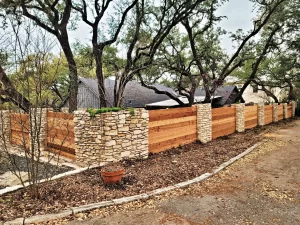
A professional install follows the same order every time, and each step exists because skipping it causes a specific failure later.
Site visit. Property lines get confirmed, the run gets measured, and the ground gets checked for rock and drainage. This is when a real contractor finds the problems.
Permits and approvals. The city permit if the height or the location calls for one, and separately the HOA if your neighborhood has design rules. They’re different approvals on different timelines.
Utility locate. Free, legally required, and the reason nobody hits a gas line. Digging before the locate is marked is how a fence project turns into a much larger problem. Marks are good for a limited window, so the dig has to follow reasonably soon after.
Demolition and clearing. The old fence comes out, the line gets cleared, and the debris leaves the property.
Posts. Holes dug, posts set plumb in concrete, concrete left to cure. Everything downstream depends on this step being right, so it’s worth reading setting posts that stay put and checking the height limits that apply to your lot before installation.
Panels and gates. Rails, pickets or panels go on, then gates get hung and adjusted so they still swing true after the ground moves.
Finish and walk. Stain or seal where the material calls for it, then a walk of the whole line with you.
The season to build in
Late fall through early spring is the better window here, and the reason is the ground rather than the air temperature. Austin clay swells when it’s wet and shrinks hard when it isn’t. A post set into summer-dry clay sits in a hole that’ll change shape around it once the rain returns.
Fall is the best of the four. You get workable soil, mild days, and crews with open calendars. Winter is close behind and usually the easiest to book, with cold snaps the only real interruption. Spring brings soft digging, but it also brings the year’s heaviest demand and the rain delays that come with it. Summer gives you long daylight and firm ground, though the heat slows everything down and dry clay can stop a manual digger cold.
None of this makes a season unusable. It changes how long the job takes and how much margin the crew needs. If your fence is already leaning, the right time is now rather than next quarter, and the real question becomes replacing an existing fence instead of scheduling around weather.
Professional, hybrid or do it yourself
There are three honest versions of this project, and the middle one gets overlooked.
Full professional. The contractor handles assessment, permits, materials, posts, panels and cleanup. That’s the route for a full perimeter, an HOA neighborhood, custom iron, or anything with an automated gate.
Hybrid. You take the work that’s physical but not technical, like clearing the yard, pulling the old fence and hauling debris. The crew takes post depth, alignment, gate hardware and code compliance. It trims labor without putting the structure at risk, and it’s the right answer more often than people assume.
Full DIY. Viable for a short run on flat ground if you own the gear and have the weekends free. Be honest about the gear, though. A manual digger loses to clay and embedded limestone, and a rented auger is usually the difference between a weekend and a month. Our rundown of fence installation tools covers what’s worth renting versus owning.
DIY savings also shrink under inspection. Tool rental, material waste from mis-cuts, and the weekends themselves all count, and rework costs more than doing it once. The honest comparison is against a professional quote, not against a materials receipt.
What drives the price
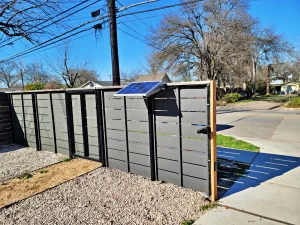
Price turns on material, height, total length, terrain and how many gates you need. A flat backyard run in cedar and a sloped perimeter in ornamental iron are different projects with different numbers, which is why per-foot figures quoted without a site visit are close to meaningless.
We keep the detail on one page rather than repeating it, so what fence installation costs breaks down what drives the total. Before you compare two quotes, it’s worth knowing how to read a fence estimate, because the cheaper number often leaves out demolition, disposal or gate hardware.
Material is the other big lever, and it’s the one homeowners underestimate. Cedar, composite, vinyl and iron all behave differently through an Austin summer, and the cheapest option at purchase is rarely the cheapest over ten years. Our guide to materials suited to Austin heat covers what holds up. If you’re weighing the spend against resale rather than against comfort, what a fence does to resale value looks at that side of it.
Choosing a contractor without getting burned
Most of the complaints we hear about fence jobs trace back to the hiring rather than the building. A few signals are reliable, and they show up before any work starts.
Walk away from: a phone number that only ever reaches voicemail; a business address that turns out to be a house; pressure to decide at the first visit; a cash-only policy; a verbal estimate never followed by a written one; a timeline nobody will commit to; and no single named person responsible for your job.
Look for: a written estimate that itemises demolition, disposal, materials and gates; a named point of contact; a real timeline with a start date; and demonstrable familiarity with the local rules. Ask directly how they’d handle a post hole that hits limestone two feet down. It happens often enough here that any experienced crew has a ready answer.
Reputation is easier to check than it used to be, and it’s worth the twenty minutes. Look at how a company answers its unhappy reviews rather than its happy ones, because the response to a problem tells you what yours would look like.
Local familiarity matters more here than people expect. Height limits, setbacks, corner-lot sight lines and historic-district rules in areas like Clarksville all vary, and a contractor who hasn’t dealt with them will find out on your project. The City of Austin fencing regulations page is the primary source for what applies. Local also shortens the job in ordinary ways: less travel per day, supplier relationships that keep materials moving, and someone who can come back if a gate needs adjusting in month three. If you’d like to start there, you can talk to us about your yard and we’ll walk the line with you.
The mistakes that cost the most
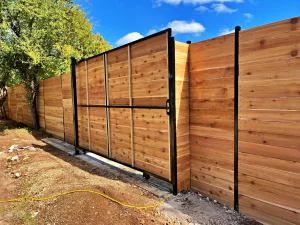
Five failures account for most of the fences we’re called out to fix, and four of them happen in the first two days of work.
Posts too shallow. In Austin clay a shallow post leans within a season. Roughly a third of the post below grade, set in concrete, is the working rule, and Austin clay post depth has the specifics by soil type.
No string line. Skipping proper alignment gives you a wavy run and uneven panel heights. It’s the first thing anyone notices.
Ignoring drainage. Water trapped at the base rots posts from the ground up. Gravel under the concrete and grading away from the post are small steps that add years.
Building past the height limit. That means fines, or removal and a rebuild. Check fence height limits before ordering material.
Untreated wood. It doesn’t survive our humidity. Whatever goes up needs the right material and then the right upkeep, so keeping a wood fence sound covers the second part and full-sun privacy fence styles covers designs that hold up in full sun.
Gates treated as an afterthought. A gate carries its own weight every time it swings, so it needs heavier posts and better hardware than the run beside it. Most sagging gates were built as though they were just another panel.
Get in front of the HOA question too, separately from the city. HOA approval requirements sets out what neighborhood rules can require and when you’ll need approval in hand, and Texas Property Code Chapter 202 is the state law that decides how far an association’s authority actually reaches. And if the yard has dogs, slopes or a pool, raise it at the site visit, because those change the design rather than just the price.