

Most residential fences in Austin don’t need a city permit. The city asks for one when the fence goes over 7 feet at any point, when it runs over 6 feet along a public right-of-way that isn’t an alley, or when any part of it sits in a floodplain. Everything else is usually build-and-go, as far as the city is concerned.
Your HOA is a separate question with a separate timeline, and it catches more people than the city does. Here’s how both work, what the application actually takes, and what it costs you to skip it. If you’d rather hand the whole thing over, a no-obligation fence estimate includes the permit check.
When Austin requires a permit

Three triggers, and they’re about height and location rather than about building a fence as such.
Over 7 feet tall at any point. Any point matters. A fence that steps up a slope can cross 7 feet at one end while measuring less everywhere else.
Over 6 feet along a public right-of-way. This one applies to residential property where the fence runs along a City of Austin right-of-way other than a public alley, and it needs an authorisation letter as well as the permit.
Anything in a floodplain. Height stops mattering here. If part of the run sits in a mapped floodplain, it needs review.
The City of Austin fencing regulations page is where those rules live, and it’s worth checking rather than trusting a contractor’s rule of thumb. What a fence may look like once it’s up is a separate matter from whether it needs a permit, and Austin fence height rules covers that side.
A permit is not the only approval that can stop you. Corner lots have sight-line requirements, historic districts add their own review, and masonry or structural walls get looked at differently from a timber fence.
The HOA question, which is not the city’s
If your neighborhood has an association, its approval runs on its own track and often takes longer than the city’s. Many Austin HOAs set material, color and style, and some require submitted drawings before anything goes in the ground.
Approval from the city does not satisfy the HOA, and the reverse holds too. what your HOA can require sets out what an association can and cannot ask for, and Texas Property Code Chapter 202 is the state law that decides how far that authority reaches.
What the application takes
Four things, and gathering them before you apply is what separates a two-week approval from a six-week one.
A site plan. Your property with the fence line drawn on it, showing height, materials and where it sits relative to boundaries, sidewalks and easements.
Property line evidence. Your deed and plat map usually suffice. Where the boundary markers have gone missing, or where a neighbour disputes the line, a surveyor settles it before the application rather than after a stop-work order.
The application form itself, filed through the city’s Build and Connect portal or in person at Development Services.
HOA documentation, where your neighborhood requires it. Attach the approval, not the request.
Fees are set by the city and scale with the project, so take the figure from the city’s current schedule rather than from a contractor’s estimate. Where permit handling sits in your overall budget is covered in what a fence costs here, and reading a fence estimate properly explains how to tell whether a quote includes it.
How long approval takes
City review on a straightforward residential fence usually runs about a week to a week and a half. An HOA adds its own one to two weeks on top, running in parallel if you’ve started both at once and in series if you haven’t.
What actually causes delay is resubmission. An incomplete site plan, a missing HOA letter or a boundary that doesn’t match the plat sends the application back, and the clock restarts. Winter is generally quicker than spring, when everyone builds at once. Permit time is the one part of a fence schedule you can’t compress, which is why how an install runs start to finish puts it at the front.
Replacing rather than building new
A like-for-like replacement on the same line, at the same height, in the same material usually needs no permit. The exceptions are the ones you’d expect: you go taller, you move the line, or the property sits in a floodplain, and then you’re back to the same triggers as new construction.
Your HOA may still want to see it even when the city doesn’t, particularly if the material or color changes. replacing a fence that is failing covers the rest of that process, and if the old fence is leaning rather than failing outright, post depth that suits Austin clay explains what usually caused it.
What skipping it actually costs
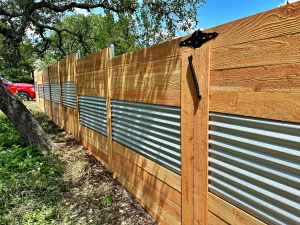
The city can issue a stop-work order mid-build, which is worse than a delay because the crew is already on site. Beyond that:
Fines, and a permit applied for after the fact rather than before.
Removal or rebuild where the finished fence breaches height or placement rules. You pay for the fence twice.
Trouble at closing. Unpermitted work turns up in a title search and becomes the buyer’s negotiating point.
Insurance friction. A claim involving unpermitted construction gets harder to settle.
HOA penalties, which run separately from anything the city does.
None of this is common, and most Austin fences need no permit at all. It’s the ones that do where skipping gets expensive.
Letting the contractor handle it
Permit handling is ordinary contractor work, and it’s reasonable to ask at the estimate stage who files, who pays the fee and what happens if the application is refused. A contractor who hasn’t dealt with Austin’s process will find out on your project.
We handle the check and the filing on the fences we install across North, Northwest and Central Austin, residential and commercial sites we fence alike, and every job carries our 1-year craftsmanship warranty.
If you want the permit question answered for your own address rather than in general, tell us about your project and we’ll look it up before anyone quotes you. our Austin fence installers raise it at the site visit as a matter of course.